
市场概况
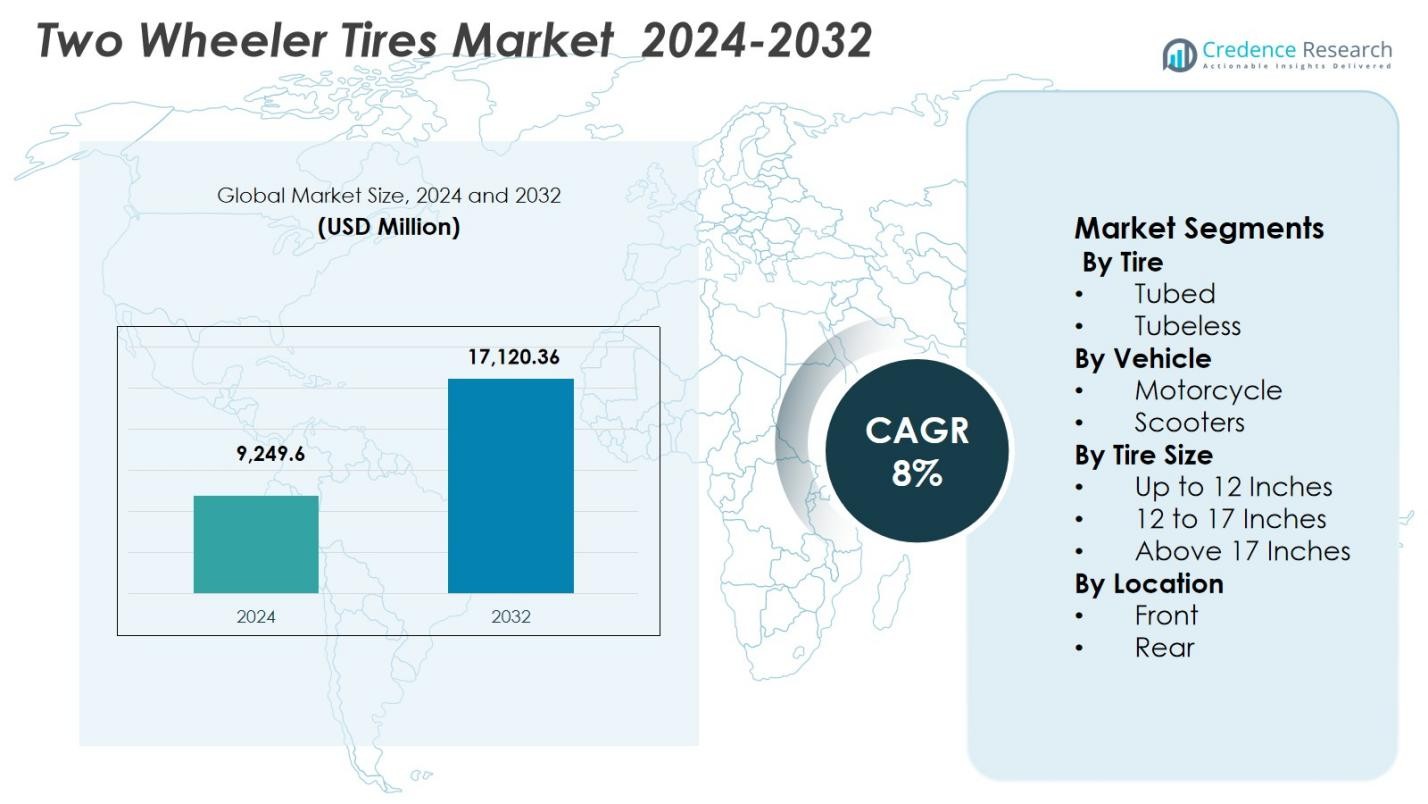
2024年,两轮车轮胎市场规模估值为92.496亿美元,预计到2032年将达到171.2036亿美元,预测期内年复合增长率为8%。| 报告属性 | 详情 |
|---|---|
| 历史时期 | 2020-2023 |
| 基准年 | 2024 |
| 预测期 | 2025-2032 |
| 2024年两轮车轮胎市场规模 | 27.458亿美元 |
| 两轮车轮胎市场,年复合增长率 | 8% |
| 2032年两轮车轮胎市场规模 | 95.0924亿美元 |
市场洞察
- 2024年两轮车轮胎市场估值为92.496亿美元,预计到2032年将达到171.2036亿美元,年复合增长率为8%。
- 不断增长的两轮车保有量、频繁的轮胎更换周期和不断扩大的城市交通强烈推动了两轮车轮胎市场的增长
- 无内胎和电动车专用轮胎设计的日益普及代表了塑造两轮车轮胎市场的关键趋势
- 非正规企业的价格压力和原材料成本的波动限制了两轮车轮胎市场的利润扩张
- 亚太地区以58.6%的市场份额领先,而无内胎以68.4%的份额在类型中占主导地位,摩托车以72.1%的份额在车辆细分市场中领先
市场细分分析:
按轮胎: 按轮胎类型划分的两轮车轮胎市场中,无内胎以68.4%的市场份额在2024年领先。无内胎因其优越的抗刺穿性、改进的骑行安全性、更好的散热性和降低的突然失压风险而占主导地位。合金轮的日益普及、对低维护轮胎的偏好增加以及中高端两轮车的渗透率提高强烈支持了无内胎的需求。OEM厂商越来越多地标准化无内胎配置,而消费者则偏好更长的轮胎寿命和燃油效率优势,巩固了该细分市场在城市和高速骑行条件下的领导地位。- 例如,皇家恩菲尔德在2024年9月为其Himalayan 450摩托车推出了无内胎辐条轮,作为新买家的工厂选项或现有车主的升级选项,价格为12,424卢比,增强了在冒险地形上的修补便利性。
- 例如,MRF为Bajaj Pulsar 150车型提供90/90-17前轮和120/80-17后轮作为OEM配件,支持17英寸轮辋上的通勤稳定性。
关键增长驱动因素
两轮车保有量增加和城市交通需求
两轮车轮胎市场受益于全球两轮车保有量的扩大,特别是在摩托车和踏板车作为日常交通主要方式的新兴经济体中。快速城市化、交通拥堵和燃油成本上升继续推动消费者转向成本效益高的两轮车。这直接增加了OEM轮胎需求,并因频繁的磨损和撕裂而创造了庞大的更换市场。最后一公里连接、网约车服务和配送车队的增长进一步加速了轮胎更换周期,支持了城市和半城市地区的持续量增长。- 例如,MRF为印度的主要两轮车OEM供应轮胎,包括本田Activa电动车、Bajaj Chetak和Hero MotoCorp的Vida电动踏板车,支持OEM产量在电动两轮车生产上升的背景下。
更换轮胎需求的增长
更换需求仍然是两轮车轮胎市场的核心增长驱动因素,支持其轮胎寿命较乘用车轮胎短。频繁使用、多变的路况和极端天气的暴露加速了胎面磨损,导致更高的更换频率。消费者越来越重视安全性、抓地力和耐用性,推动了稳定的售后市场需求。组织化零售网络、经销商连锁店和电子商务平台的扩展提高了产品的可用性和品牌知名度,进一步加强了发达和发展中市场中摩托车和踏板车的更换销售。- 例如,印度使用MRF或CEAT等轮胎的食品配送和电子商务车队在城市道路上24/7高负荷运营中频繁更换轮胎,促使对耐用选项的需求。
对性能和安全的关注增加
消费者对骑行安全和性能的意识提高显著支持了两轮车轮胎市场。骑行者越来越追求提供优越抓地力、稳定性、制动效率和湿路性能的轮胎。这一转变在高端摩托车车主和高速通勤细分市场中尤为强烈。制造商继续推出先进的胎面设计、硅基化合物和强化结构以满足不断变化的性能期望。对道路安全和质量标准的监管强调进一步鼓励采用更高质量的轮胎,支持价值增长与量扩张。关键趋势与机遇
向无内胎的转变
两轮车轮胎市场正在经历向无内胎的明显转变,为制造商创造了强劲的增长机会。与有内胎相比,无内胎提供了更好的抗刺穿性、更好的散热性、增强的燃油效率和更容易的维护。OEM厂商越来越多地在新摩托车和踏板车车型中标准化无内胎,加速了渗透。这一趋势为高端定价、技术差异化和高利润产品开辟了机会,特别是在消费者重视便利性、安全性和长期成本效益的城市市场中。- 例如,KTM最新的390 Adventure车型使用21英寸前轮(90/90-21)和17英寸后轮(130/80-17)无内胎辐条轮,具有专利的中心安装辐条和橡胶密封以实现气密性能。
电动两轮车的扩展
电动两轮车的快速普及为两轮车轮胎市场带来了显著的机会。电动踏板车和摩托车需要专门设计的轮胎,以应对更高的扭矩、更低的噪音和增强的耐用性。制造商正在投资于电动车专用轮胎设计,以满足独特的性能要求。政府激励措施、城市电气化计划和可持续发展目标正在加速电动车的渗透,创造了新的需求池。这一趋势支持了以创新为导向的增长,并允许轮胎制造商加强与新兴电动两轮车OEM的合作。- 例如,TVS Eurogrip推出了ETorq轮胎,这是印度首款专为电动两轮车设计的轮胎,具有低滚动阻力以延长续航里程,同时提供卓越的湿地和干地抓地力以应对瞬时扭矩。
关键挑战
原材料价格波动
天然橡胶、合成橡胶和原油衍生物等关键原材料价格的波动对两轮车轮胎市场构成了重大挑战。成本波动直接影响生产费用和利润率,限制了在竞争激烈的市场中的定价灵活性。较小的制造商由于成本吸收能力有限而面临更大的压力。持续的原材料通胀可能会扰乱供应链,并迫使制造商优化配方、重新谈判供应商合同或吸收成本,可能影响长期盈利能力和运营稳定性。激烈的价格竞争和假冒产品
两轮车轮胎市场由于众多地区和非正规企业提供低成本替代品而面临强大的价格压力。激烈的竞争限制了利润扩张,尤其是在价格敏感的市场。此外,假冒和劣质轮胎的流通破坏了品牌声誉并引发安全问题。这些产品往往吸引注重成本的消费者,影响了知名品牌的销售。解决这一挑战需要更强的分销控制、消费者意识倡议以及在品牌差异化和质量保证方面的持续投资。区域分析
亚太地区
亚太地区以58.6%的市场份额领先两轮车轮胎市场,得益于高两轮车渗透率、大量通勤人口和强大的国内制造基地。印度、中国、印度尼西亚和越南等国家由于日常交通需求和可支配收入的增加推动了量需求。该地区受益于强劲的更换轮胎周期、扩大的道路基础设施以及需要专用轮胎的电动两轮车的增长。当地制造商和全球品牌积极投资于产能扩张、产品本地化和成本效益的分销网络,巩固了亚太地区作为最大和增长最快的区域市场的地位。欧洲
欧洲在两轮车轮胎市场占据17.9%的市场份额,受益于高端摩托车拥有量、严格的安全标准以及对高性能和专业轮胎的强劲需求。德国、意大利、法国和西班牙等国家通过休闲摩托车、旅游文化和城市交通踏板车支持了持续的需求。对轮胎质量、湿地抓地性能和可持续性的监管强调加速了先进化合物和径向无内胎设计的采用。更换需求主导市场,而城市中心电动踏板车的日益普及进一步加强了区域增长前景。北美
北美在两轮车轮胎市场占据12.4%的市场份额,受益于对重型摩托车、运动自行车和休闲骑行的强劲需求。美国由于高端摩托车车主的庞大基数以及由性能骑行和长途旅行驱动的频繁轮胎更换而引领区域消费。消费者对品牌、高耐用性和性能导向轮胎的偏好高,惠及高端制造商。城市踏板车和电动两轮车在某些城市的增长也有助于市场多样化,而成熟的售后市场分销渠道确保了稳定的需求。拉丁美洲
拉丁美洲在两轮车轮胎市场占据7.1%的市场份额,受益于用于日常通勤和配送服务的经济型两轮车。巴西、墨西哥、哥伦比亚和阿根廷由于城市拥堵加剧和中等收入人群中两轮车拥有量的增加而成为关键贡献者。市场主要由更换驱动,对适合混合路况的耐用、经济实惠的无内胎需求强劲。电子商务、食品配送平台和最后一公里物流的扩展继续增加轮胎磨损率,支持了稳定的区域需求增长。中东和非洲
中东和非洲地区在两轮车轮胎市场占据3.9%的市场份额,受益于非洲两轮车采用的增长和中东选择性高端摩托车需求。在非洲,摩托车广泛用于经济型交通和商业出租车服务,推动了高更换轮胎需求。尼日利亚、肯尼亚和坦桑尼亚等国家仍然是关键的量市场。在中东,休闲和性能摩托车支持了高端轮胎细分市场的需求,而逐步的基础设施改善和城市交通计划有助于市场扩展。市场细分:
按轮胎- 有内胎
- 无内胎
- 摩托车
- 踏板车
- 12英寸及以下
- 12至17英寸
- 17英寸以上
- 前轮
- 后轮
- 北美
- 美国
- 加拿大
- 墨西哥
- 欧洲
- 德国
- 法国
- 英国
- 意大利
- 西班牙
- 欧洲其他地区
- 亚太地区
- 中国
- 日本
- 印度
- 韩国
- 东南亚
- 亚太其他地区
- 拉丁美洲
- 巴西
- 阿根廷
- 拉丁美洲其他地区
- 中东和非洲
- 海湾合作委员会国家
- 南非
- 中东和非洲其他地区
竞争格局
两轮车轮胎市场的竞争格局分析突出了MRF、米其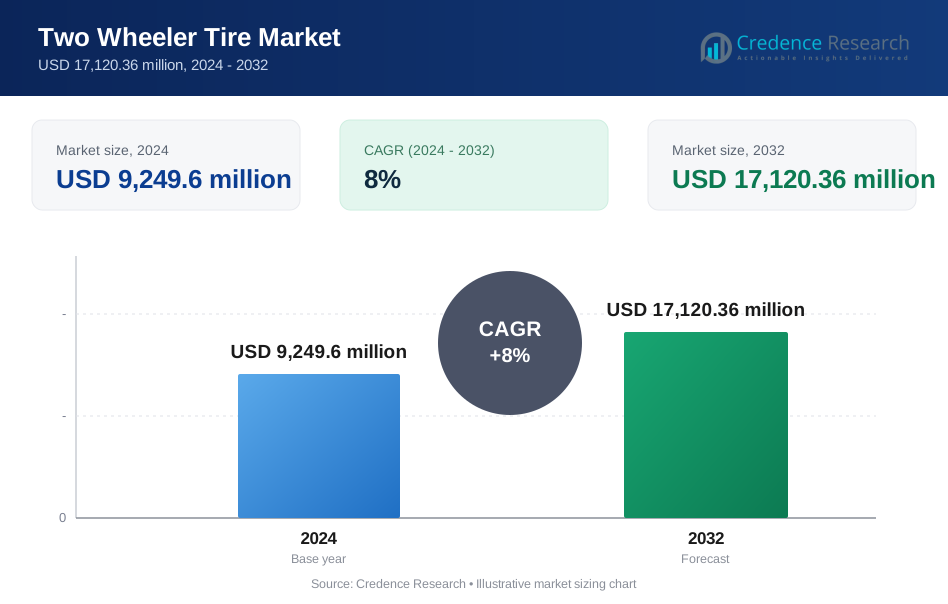
申请免费样本
填写您的信息,我们将为您发送免费样本报告。
- Sample data tables & charts
- Research methodology
需要本报告的定制版本?
根据您的确切需求定制研究范围、地域或细分市场。
- 定制地域或细分市场范围
- 直接对接我们的分析师团队
常见问题解答
目前两轮车轮胎市场的市场规模是多少?预计到2032年将达到多大规模?
在2024年至2032年期间,两轮车轮胎市场预计将以什么复合年增长率增长?
2024年哪个两轮车轮胎市场细分占据了最大的份额?
推动两轮车轮胎市场增长的主要因素是什么?
两轮摩托车轮胎市场的领先公司有哪些?
2024年哪个地区在两轮车轮胎市场中占据了最大的份额?
目录
Chapter 1. Report Introduction
- 1.1 Report Description & Purpose
- 1.1.1 Report Title & Market Definition
- 1.1.2 Unique Selling Propositions (USP) & Key Differentiators
- 1.1.3 Value Proposition for Stakeholders
- 1.2 Research Objectives
- 1.2.1 Market Sizing Objectives (Volume & Revenue)
- 1.2.2 Segmentation Objectives
- 1.2.3 Competitive Intelligence Objectives
- 1.2.4 Forecast & Scenario Objectives
- 1.3 Report Scope
- 1.3.1 两轮车轮胎市场 Scope – Types & Subtypes Covered
- 1.3.2 Geographic Scope – Regions & Countries Covered
- 1.3.3 Historical Period, Base Year & Forecast Period (2024; forecast to 2032)
- 1.3.4 Inclusions & Exclusions
- 1.4 HS Code & Classification Framework
- 1.5 Currency, Units & Pricing Basis
- 1.6 Target Stakeholders
- 1.7 Limitations & Assumptions
Chapter 2. Executive Summary
- 2.1 Global 两轮车轮胎市场 Market Snapshot
- 2.1.1 Market Size – Historical (2024) & Forecast (2024-2032) (2024: USD 9,249.6 million → 2032: USD 17,120.36 million)
- 2.1.2 Volume & Revenue – Global Totals
- 2.1.3 Key Market Highlights – Top Five Facts
- 2.2 两轮车轮胎市场 Market Segmentation Snapshot
- 2.2.1 Market Split by Region – 2024 vs. 2032
- 2.3 Competitive Snapshot
- 2.3.1 Top 10 Players by Revenue Share – 2024
- 2.3.2 Top 10 Players by Volume Share – 2024
- 2.3.3 Recent Strategic Developments (18-Month Summary)
- 2.4 Key Investment Highlights & Strategic Conclusions
Chapter 3. 两轮车轮胎市场 Market Dynamics & Industry Analysis
- 3.1 Market Overview & Context
- 3.1.1 两轮车轮胎市场 Market Position in the Broader Automotive Value Chain
- 3.1.2 OEM vs. Replacement Market Dynamics
- 3.1.3 Market Maturity & Development Stage by Region
- 3.2 两轮车轮胎市场 Market Drivers
- 3.3 两轮车轮胎市场 Market Restraints & Challenges
- 3.4 两轮车轮胎市场 Market Opportunities
- 3.5 Porter's Five Forces Analysis
- 3.5.1 Threat of New Entrants
- 3.5.2 Bargaining Power of Suppliers
- 3.5.3 Bargaining Power of Buyers
- 3.5.4 Threat of Substitutes
- 3.5.5 Competitive Rivalry – Intensity Assessment
- 3.6 两轮车轮胎市场 Value Chain Analysis
- 3.6.1 Upstream – Raw Material/Input Suppliers
- 3.6.1.1 Raw Material/Input 1
- 3.6.1.2 Raw Material/Input 2
- 3.6.1.3 Raw Material/Input 3
- 3.6.2 Midstream – Production/Manufacturing/Service Delivery
- 3.6.2.1 Production/Process Overview
- 3.6.2.2 Key Facility Locations & Capacity by Manufacturer
- 3.6.3 Downstream – Distribution & End Consumer
- 3.6.3.1 Primary Channel – B2B/OEM
- 3.6.3.2 Secondary Channels – Dealer, Retail, Online, Direct
- 3.6.4 Value Chain Profitability Analysis
- 3.6.1 Upstream – Raw Material/Input Suppliers
- 3.7 PESTEL Analysis
- 3.7.1 Political Factors
- 3.7.2 Economic Factors
- 3.7.3 Social Factors
- 3.7.4 Technological Factors
- 3.7.5 Environmental Factors
- 3.7.6 Legal Factors
- 3.8 两轮车轮胎市场 Supply Chain Analysis
- 3.8.1 Raw Material/Input Supply Risk Assessment
- 3.8.2 Manufacturing Concentration Risk (Geographic Exposure)
- 3.8.3 Trade Disruption Impact Analysis
- 3.9 Regulatory & Policy Landscape
Note: The regulatory and policy landscape section covers regulations based on their applicability to the market, 两轮车轮胎市场 category, geography, and scope of the study. Only regulatory frameworks with a material impact on operations, compliance, trade, sustainability, or market access are analyzed in detail.
Chapter 4. Key Investment Pockets & Opportunity Analysis
- 4.1 两轮车轮胎市场 Market Attractiveness Analysis
- 4.1.1 By Region – Investment Attractiveness Matrix (Volume × CAGR)
- 4.2 Absolute Revenue Growth Opportunity
- 4.2.1 By Region – Absolute USD Growth Through 2032
- 4.3 Incremental Volume Opportunity
- 4.3.1 By Region – Incremental Volume Through 2032
- 4.3.2 Segment – Incremental Volume
- 4.4 Emerging Submarket Opportunity Deep Dive (Subject to Applicability)
- 4.5 Emerging Market Opportunity Scorecards
- 4.5.1 United States
- 4.5.2 Europe
- 4.5.3 Asia
- 4.5.4 Middle East & Africa
Note: Emerging Market Opportunity Scorecards will be included based on relevance and strategic importance. Regions listed are indicative and may vary depending on data availability and market dynamics.
Chapter 5. 两轮车轮胎市场 Import-Export Analysis & Trade Flows
- 5.1 Global Trade Overview
- 5.1.1 Global Export Value by Country (2024)
- 5.1.2 Global Export Volume by Country (2024)
- 5.1.3 Global Import Value by Country (2024)
- 5.1.4 Global Import Volume by Country (2024)
- 5.1.5 Net Trade Balance by Country (2024)
- 5.2 Export Analysis – Segment
- 5.2.1 Type 1 (HS Code)
- 5.2.2 Type 2 (HS Code)
- 5.2.3 Type 3 (HS Code)
- 5.2.4 Type 4 (HS Code)
- 5.2.5 Type 5 (HS Code)
- 5.3 Import Analysis – Segment
- 5.3.1 Type 1 (HS Code)
- 5.3.2 Type 2 (HS Code)
- 5.3.3 Type 3 (HS Code)
- 5.3.4 Type 4 (HS Code)
- 5.3.5 Type 5 (HS Code)
- 5.4 Average Unit Trade Prices
- 5.4.1 Average Export Price – Segment & Country
- 5.4.2 Average Import Price – Segment & Source Country
- 5.4.3 Price Trends (2024)
- 5.5 Key Trade Route Analysis
- 5.5.1 Trade Route 1
- 5.5.2 Trade Route 2
- 5.5.3 Trade Route 3
- 5.5.4 Trade Route 4
- 5.5.5 Trade Route 5
- 5.6 Trade Policy Impact Assessment
- 5.6.1 US Anti-Dumping & Section 301 Tariffs
- 5.6.2 EU Customs Union Impact
- 5.6.3 Major Free Trade Agreements
- 5.6.4 USMCA Rules of Origin
Note: Trade policy analysis will be included only where relevant to the 两轮车轮胎市场 market.
Chapter 6. Competitive Landscape & Company Benchmarking
- 6.1 两轮车轮胎市场 Market Concentration & Structure
- 6.1.1 Herfindahl-Hirschman Index (HHI) – vs. 2024
- 6.1.2 Tier 1, Tier 2 & Tier 3 Market Structure
- 6.1.3 Global, Regional & Local Player Dynamics
- 6.2 两轮车轮胎市场 Market Share Analysis – 2024
- 6.2.1 Global Revenue Share by Company
- 6.2.2 Global Volume Share by Company
- 6.2.3 Regional Revenue Share
- 6.2.4 Market Share Evolution ( vs. 2024)
- 6.2.5 OEM Segment Share by Company
- 6.2.6 Replacement Segment Share by Company
- 6.3 Production/Delivery Capacity & Facility Analysis
- 6.3.1 Global Installed Capacity
- 6.3.2 Capacity Utilization Rates
- 6.3.3 Production/Output Volume
- 6.3.4 Facility Locations & Capacity Map
- 6.3.5 Planned Capacity Additions
- 6.4 两轮车轮胎市场 Competitive Benchmarking Matrix
- 6.4.1 Revenue, Volume, CAGR & Profitability Comparison
- 6.4.2 Channel Revenue Mix
- 6.4.3 Geographic Revenue Exposure
- 6.4.4 R&D Intensity
- 6.4.5 Sustainability Maturity
- 6.5 Strategic Developments in 两轮车轮胎市场 (Last 24 Months)
- 6.5.1 Mergers, Acquisitions & Divestments
- 6.5.2 New 两轮车轮胎市场 Launches
- 6.5.3 Facility Expansions
- 6.5.4 Strategic Alliances, Joint Ventures & Partnerships
- 6.5.5 Distribution Expansion & Market Entry
- 6.5.6 Sustainability & ESG Initiatives
- 6.6 Competitive Strategy Mapping
- 6.6.1 Leader, Challenger, Follower & Niche Classification
- 6.6.2 Pricing Strategy Comparison
- 6.6.3 Channel Strategy Matrix
Note: Strategic developments are included based on their materiality and the availability of reliable information.
Chapter 7. Global 两轮车轮胎市场 Market – By Distribution Channel
- 7.1 Segment Overview
- 7.1.1 Volume & Revenue Split by Channel (2024 & 2032)
- 7.1.2 Channel Mix Evolution (2024-2032)
Chapter 8. Regional Market Analysis – Global Overview
- 8.1 Global Regional Overview
- 8.1.1 Regional Volume Share
- 8.1.2 Regional Revenue Share
- 8.1.3 Regional Volume by Region
- 8.1.4 Regional Revenue by Region
- 8.1.5 Regional Forecast Through 2032
- 8.2 Cross-Regional Segment Analysis
- 8.2.1 By Distribution Channel
- 8.2.2 By Brand/Price Tier
Chapter 9. North America 两轮车轮胎市场 Market
- 9.1 United States
- 9.2 Canada
- 9.3 Mexico
Chapter 10. Europe 两轮车轮胎市场 Market
- 10.1 Germany
- 10.2 France
- 10.3 Italy
- 10.4 United Kingdom
- 10.5 Spain
- 10.6 Poland
- 10.7 Russia
- 10.8 Netherlands
- 10.9 Belgium
- 10.10 Sweden
- 10.11 Denmark
- 10.12 Norway
- 10.13 Rest of Europe
Chapter 11. Asia Pacific 两轮车轮胎市场 Market
- 11.1 China
- 11.2 India
- 11.3 Japan
- 11.4 South Korea
- 11.5 Thailand
- 11.6 Indonesia
- 11.7 Vietnam
- 11.8 Malaysia
- 11.9 Australia
- 11.10 Rest of Asia Pacific
Chapter 12. Latin America 两轮车轮胎市场 Market
- 12.1 Brazil
- 12.2 Argentina
- 12.3 Colombia
- 12.4 Chile
- 12.5 Rest of Latin America
Chapter 13. Middle East 两轮车轮胎市场 Market
- 13.1 Saudi Arabia
- 13.2 United Arab Emirates
- 13.3 Turkey
- 13.4 Israel
- 13.5 Iran
- 13.6 Rest of the Middle East
Chapter 14. Africa 两轮车轮胎市场 Market
- 14.1 South Africa
- 14.2 Egypt
- 14.3 Nigeria
- 14.4 Morocco
- 14.5 Rest of Africa
Chapter 15. 两轮车轮胎市场 Company Profiles
- 15.1 [Company 01]
- 15.1.1 Company Overview
- 15.1.2 Key Management Personnel
- 15.1.3 Products & Services Portfolio
- 15.1.4 Financial Performance
- 15.1.5 Key Market Focus & Geographic Presence
- 15.1.6 Recent Developments & Strategic Initiatives
Note: The company profile list is preliminary and may change based on research findings, market developments, data availability, and client requirements.
Chapter 16. Appendices
- Appendix A – List of Abbreviations & Acronyms
- Appendix B – Industry Classification Code Reference – Full Series
- Appendix C – Production & Capacity Data Tables
- Appendix D – End-Use & Demand Base Tables
- Appendix E – Consumption & Replacement Rate Assumptions
- Appendix F – ASP Reference Tables
- Appendix G – Manufacturing & Facility Database
- Appendix H – Import-Export Data Tables
- Appendix I – Regulatory Summary Tables
- Appendix J – Primary Research Participant List (Anonymized)
- Appendix K – Primary Research Questionnaire Framework
- Appendix L – Data Sources & Bibliography
- Appendix M – Market Size Divergence & Source Comparison
Chapter 17. Research Methodology
- 17.1 Research Framework & Philosophy
- 17.2 Secondary Research – Sources, Hierarchy & Data Extraction
- 17.3 Data Modeling – Bottom-Up & Top-Down Market Sizing
- 17.4 Primary Research – Stakeholder Framework, LOI & Sample Sizes
- 17.5 Forecast Methodology – Regression, Scenario & Sensitivity Analysis
- 17.6 Quality Control – Four-Layer Validation Framework
- 17.7 Limitations & Standard Assumptions
- 17.8 Disclaimer
